Introduction:
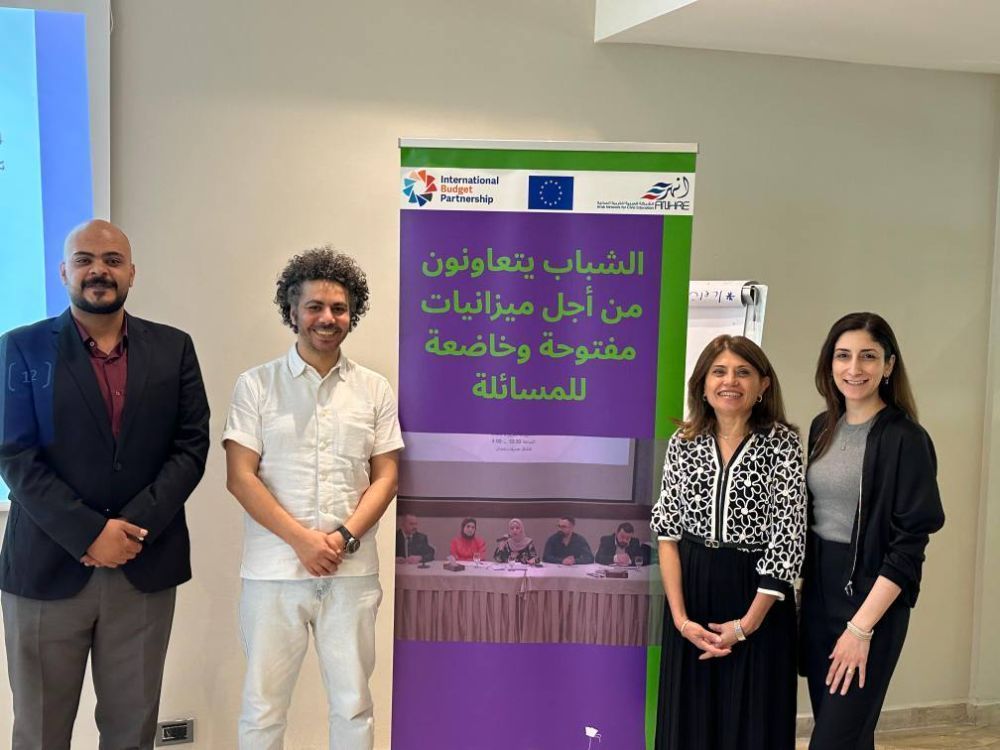
The Arab Network for Civic Education – ANHRE has launched the project “Youth Collaborate for Open and Accountable Budgets” in partnership with the International Budget Partnership (IBP). Running from August 2024 to July 2026, the project targets young activists from across the Kingdom to engage them in meaningful participation in the national budgeting process, with the aim of advancing Sustainable Development Goal 4 (SDG 4), which ensures inclusive and equitable quality education for all.
Current Context:
The Ministry of Education in Jordan has extended its Education Strategic Plan, originally set for 2021/2022, through to 2025. According to the Ministry’s 2021/2022 Annual Monitoring and Evaluation Report, spending on education in Jordan remained at approximately 3.5% of GDP and 10% of government expenditure. International benchmarks for adequate education financing, established in 2015 under the Incheon Declaration for Education 2030, urge countries to allocate at least 4–6% of GDP and/or 15–20% of total public expenditure to education.
Jordan currently hosts 34 off-budget educational projects funded by various international organizations such as the World Bank, European Union, UNESCO, UNICEF, GIZ, and the German Development Bank (KfW). These projects serve diverse objectives, including school construction, inclusive education, refugee support, and assistance to host communities.
A significant development occurred in June 2023, when the World Bank reclassified Jordan as a lower-middle-income country, down from its previous upper-middle-income status. This reclassification compounds the challenge of securing sufficient domestic budget allocations for education.
During the Transforming Education Summit (TES) held in September 2022, Jordan reaffirmed its commitment to transforming education, emphasizing the need for coordinated financial and institutional efforts to maintain momentum towards achieving SDG 4 and the Education Strategic Plan (ESP). The government pledged to ensure sustainable and adequate financing aligned with Jordan’s educational needs.
Based on the new Strategic Plan of the Ministry of Education (2026–2030), education allocations increased from JOD 1,332 million in 2024 to JOD 1,452.6 million in 2025, and further to JOD 1,560 million in 2026.
Education allocations accounted for 11.6% of total public sector expenditures in 2024, rising to 11.8% in 2025 and 11.95% in 2026, while this share declined in some other sectors. This reflects increased government attention to the education sector.
The education sector ranked fourth in terms of share of public spending among economic sectors, following general public services, social protection, and public order and safety.
Despite the gradual increase, education spending remains below international standards when measured against GDP. Most spending continues to be concentrated on salaries, wages, operations, maintenance, congestion response, and infrastructure, which limits capital investment. As a result, the increase is more compensatory than reform-oriented.
Government spending on education in Jordan is approximately 3.5% of GDP, which is below international benchmarks and does not keep pace with enrollment expansion, thereby limiting improvements in quality and innovation.
Recurrent expenditures dominate the education budget (around 90% allocated to salaries and benefits), significantly reducing the resources available for capital investment and strategic reforms.
Despite these commitments, there remains a gap in public awareness—especially among citizens and youth—regarding the budgeting and allocation process. This limited awareness hinders understanding of how an effective education budget can directly support equitable, quality, and free access to education for all.
Rationale for the Project:
National budget formulation is often viewed as a highly technical and specialized process, typically limited to economists and financial experts. Consequently, young people are generally excluded from national budgeting conversations.
It is therefore essential to promote youth engagement in budget formulation and monitoring. Social accountability mechanisms can enhance the proper use of public funds. Citizens, including youth, can be involved in participatory budgeting, public expenditure tracking, monitoring public service delivery, and initiating advocacy campaigns.
Project Objectives:
General Objective:
To promote meaningful youth participation in budget analysis processes to ensure progress toward Sustainable Development Goal 4 (SDG 4) by 2030.
Specific Objectives:
-
To enhance youth skills in analyzing open national budgets.
-
To empower youth to apply these skills through examining and analyzing the education budget specifically.
Expected Results:
-
Increased knowledge, awareness, and skills among youth regarding general budget analysis and the education budget in particular.
Project Activities:
-
A workshop with the participation of 20 young men and women from across the Kingdom.
-
Development of a participatory budget analysis tool to equip youth education advocates with new skills.
-
Organization of follow-up and practical application meetings .
-
Development of Policy Papers.