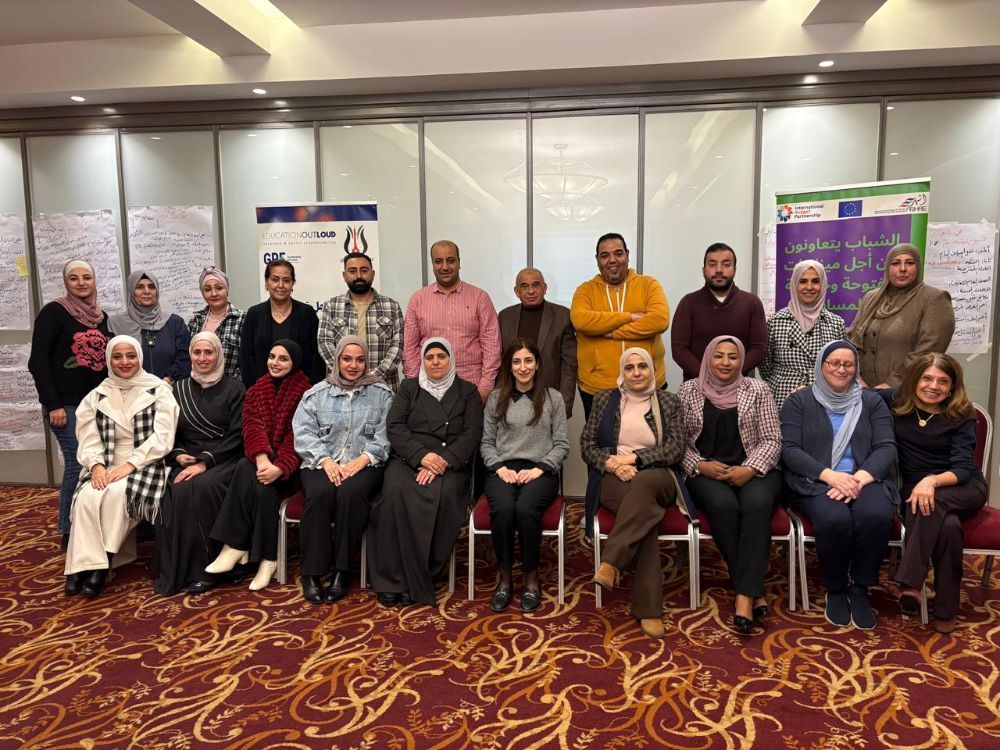
The Jordan Network for Education for All (JNEFA), formerly known as the Jordan Coalition for Education for All (JCEA), concluded a specialized technical training workshop on facilitating multi-stakeholder policy dialogue sessions under the Education Out Loud program, funded by Oxfam Denmark / the Global Partnership for Education. The workshop was held on 10–11 February 2026 at the Geneva Hotel, with the participation of a group of representatives from civil society organizations that are members of the Jordan Network for Education for All.
The workshop opened with a welcoming address emphasizing the importance of evidence-based dialogue in the development of education policies. This was followed by a presentation introducing the training objectives and an executive summary of the project’s policy priorities, which focus on strengthening inclusive education, enhancing community participation, and linking national education policies to the local context.
The training included sessions aimed at understanding the broader education policy context through the use of various analytical tools, including SWOT analysis and stakeholder analysis, with the goal of developing an in-depth analysis of the proposed policies and presenting the results through interactive exercises. Participants also discussed three main thematic areas representing priority policy issues for the education sector, most notably:
-
Reviewing inclusion standards to ensure an inclusive school culture, with a focus on activating the role of teachers, investing in their capacities through training and professional development, examining the distribution of inclusive schools, adapting curricula and staff, and improving accessibility and access to educational services.
-
Promoting a policy for the inclusion of persons with disabilities in technical and vocational education and training (BTEC), to enhance their opportunities in education, training, and employment.
-
Strengthening the role of Parents’ Councils through a clear and formal mechanism to engage them in educational decision-making and improve the quality of education.
These discussions contributed to the development of a clear action plan for conducting local-level policy dialogue sessions.
On the second day, the sessions focused on introducing the concept and objectives of multi-stakeholder dialogue sessions, outlining the elements of effective dialogue and planning mechanisms. Participants worked on finalizing their dialogue session plans and designing guiding questions to support evidence-based discussions and help generate practical recommendations.
The second day also featured presentations of group work results through a simulation exercise of the dialogue sessions, which enabled participants to practice conducting realistic policy dialogues and to strengthen their facilitation and communication skills. This contributed to enhancing their readiness to manage effective participatory dialogues at both the local and national levels.
At the conclusion of the workshop, the Network reaffirmed its commitment to continuing to support national efforts aimed at developing more inclusive and equitable education policies, and to building participatory dialogue platforms that amplify the voices of education stakeholders and local communities in decision-making processes.
For More about EOL click here
For more photos Click Here
To know more click Here